
Sheep are pregnant for an average of 147 days — about five months, or 21 weeks — with a normal range of roughly 144 to 152 days depending on breed, litter size and ewe condition (MSD/Merck Veterinary Manual). Enter the breeding date in the sheep gestation calculator above to get your ewe’s expected lambing date, the normal lambing window, and dated management milestones.

How the sheep gestation calculator works
The math is simple and matches what reproduction specialists use: breeding date + 147 days = expected lambing date. The 147-day figure is the published average for domestic sheep (Ovis aries) confirmed by both the Merck/MSD Veterinary Manual and Montana State University Extension. Because ewes are usually run with a ram rather than served by hand, the exact conception date is seldom known, so the calculator also shows the full lambing window around your due date rather than a single day.
How long is the gestation period for sheep?
The gestation period for sheep averages 147 days, but individual pregnancies vary. Montana State University Extension reports typical gestation lengths of 144 to 151 days, while University of Missouri Extension gives a range of 144 to 152 days. In months, that is roughly four months and three weeks — commonly rounded to “about five months.” Outliers do occur: Montana State notes individual pregnancies can span 138 to 159 days, so a healthy lamb arriving a few days either side of the calculated date is normal. Litter size plays a role too — ewes carrying twins or triplets often lamb slightly earlier than those carrying a single.
Some producers work from a 145-day figure and others from 147 or even 150 days; all fall inside the same normal window. That is why you’ll see 145-day and 147-day sheep gestation tables in circulation. BarnCalc defaults to the well-documented 147-day average and shows the 144–152 day range so you know when to start watching.
Sheep gestation chart by breed
Breed makes only a small difference to gestation length — typically a day or two — so all common breeds are calculated on the 147-day average. The table below summarises where widely raised breeds sit within the normal window.
| Breed / type | Typical gestation | Notes |
|---|---|---|
| Suffolk / Texel (meat) | ~144–148 days | Cluster around the 147-day mean |
| Dorper | ~147 days | Tracks the standard sheep average |
| Katahdin & other hair sheep | ~147 days | Same average as wooled breeds |
| Merino / Romney (wool) | ~147–150 days | Sit toward the upper end of the range |
| Babydoll (miniature) | ~147 days | Miniatures gestate like standard sheep |
| Icelandic | ~147 days | Watch from day 144 onward |
For a full breeding-date → due-date sheep gestation table (with 145-, 147- and 150-day columns), open the collapsible chart inside the calculator above and print it for the barn wall.
How to use the calculator
- Enter the breeding (tupping) date. If a ram ran with the flock for several weeks, use the midpoint of that period, or enter individual service dates if you keep records.
- Optionally choose the breed and expected litter size for a tailored note.
- Read the expected lambing date, the earliest/latest window, and the dated milestones for scanning, feeding and pre-lambing prep.
- Use Print / save to keep a copy or add it to your lambing calendar.
BarnCalc · Sheep
Sheep Gestation Calculator
Enter the breeding (tupping) date to get your ewe’s expected lambing date, the normal lambing window, and key management milestones.
Expected lambing date
—
Based on a 147-day average gestation.
Management milestones
- Enter a breeding date to see scanning, feeding and pre-lambing dates.
Sheep gestation chart — breeding date → due date
| If bred on | 145 days | 147 days | 150 days |
|---|
Columns show the three conventions producers commonly use. BarnCalc defaults to the 147-day average.
Key dates during pregnancy
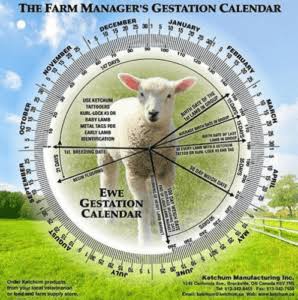
Two milestones are worth marking on every ewe’s calendar. Pregnancy can be confirmed by ultrasound from about 30 days, and the best window for counting fetuses is 40 to 70 days after breeding, which helps you feed singles and multiples appropriately (Merck/MSD Veterinary Manual). In the final stretch, the widely accepted protocol is to give the ewe her CD/T (clostridial/tetanus) booster 4 to 6 weeks before lambing so antibodies pass to the lamb through colostrum (Penn State Extension; Maryland Small Ruminant Program). This is the same window in which many shepherds crutch or shear and step up late-gestation nutrition.
Frequently asked questions
How long is a sheep’s gestation period?
About 147 days on average, with a normal range of roughly 144 to 152 days. In months that is close to five months.
How many months are sheep pregnant?
Roughly four months and three weeks, or about 21 weeks — usually described as “about five months.”
Does gestation differ for Dorper, Katahdin, Babydoll or hair sheep?
Not meaningfully. All common breeds average around 147 days; differences between breeds are typically only a day or two, so the same calculator works for every breed.
Do twins or triplets change the due date?
They can. Ewes carrying multiples often lamb a day or two earlier than those carrying a single, which is one reason lambing is expressed as a window rather than a fixed day.
What’s the difference between sheep and goat gestation?
Sheep average about 147 days; goats average about 150 days (range roughly 145–155). If you run both, use the goat gestation calculator for does.
When should I start watching for lambing?
Begin close monitoring from day 144 after breeding. Lambs arriving between days 144 and 152 are within the normal range; before day 142 is early and may need extra care.
Sources
- MSD/Merck Veterinary Manual — Breeding, Parturition and Common Lamb Diseases of Sheep: msdvetmanual.com
- Merck Veterinary Manual — Prolonged Gestation in Cattle and Sheep: merckvetmanual.com
- Montana State University Extension — Reproduction in Sheep: animalrangeextension.montana.edu
- University of Missouri Extension — Breeding Season Considerations for Sheep and Goats: extension.missouri.edu
- Penn State Extension — Off-Season and Accelerated Lamb Production: extension.psu.edu
Reviewed for accuracy against the Merck/MSD Veterinary Manual and Montana State, Missouri and Penn State University Extension publications. Last updated: July 12, 2026.
Related calculators: visit the sheep hub for more tools, or try the goat gestation calculator, the sheep heat cycle & breeding calculator, and the cattle gestation calculator.