
Goose eggs incubate for about 30 days, though the practical hatch window runs from roughly 28 to 35 days depending on breed, egg size and how the eggs were stored and incubated (FAO, A Basic Guide to Waterfowl Production). Enter the date you set your eggs into the calculator above and it counts forward to your goose egg incubation hatch date, gives you a realistic hatch window, and lays out the candling, cooling and lockdown milestones along the way.
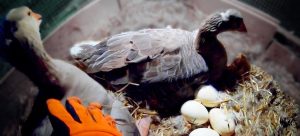
The number the calculator uses
The tool defaults to a 30-day goose incubation period — the standard figure used by the FAO — and adjusts by a day or two when you pick a heavier breed. It then adds days from your set date using timezone-safe date math, so the hatch date and every milestone stay accurate across month and year boundaries. Because real hatches drift with egg size and incubator performance, the calculator shows a window rather than a single guaranteed day, and reminds you to confirm progress by candling.
How long is the goose incubation period?
Most domestic goose eggs hatch around day 30, with a normal goose egg incubation time of 28 to 35 days. Lighter breeds such as Chinese and African geese tend toward the shorter end, while heavier Embden and Toulouse eggs can run a few days longer (Metzer Farms; Tyrant Farms). Wild Canada goose eggs are quicker, incubating for roughly 28 days (range 25–30) under the female (Wildlife Illinois; Indiana DNR). Individual eggs vary even within one breed, so treat the day count as a planning anchor, not a deadline.
Goose egg incubation chart: days, temperature and humidity
This goose incubation chart pulls together the incubation length by type and the temperature and humidity targets most reputable references agree on. Use the breed row to set your expected hatch day, and the settings rows to run the incubator.
| Goose type | Typical incubation |
|---|---|
| Chinese | ~28–30 days |
| African | ~30–31 days |
| Embden | ~30–33 days |
| Toulouse | ~32–34 days |
| Pilgrim / Roman / American Buff | ~30 days |
| Sebastopol | ~30 days |
| Wild Canada goose | ~28 days (25–30) |
| Stage | Temperature (forced-air) | Humidity | Turning |
|---|---|---|---|
| Days 1–27 (setting) | 99.5°F / 37.5°C | 50–55% RH | 4–6× per day |
| Lockdown (last ~3 days) | 99–99.5°F | 65–75% RH | Stop turning |
Temperature figures follow Kansas State University Extension (99–99.5°F for goose eggs) and the FAO setter recommendation of about 37.5–37.7°C. Goose eggs also benefit from a waterfowl-specific routine of daily cooling and misting from roughly day 4 to day 27 — briefly opening the incubator and spraying the eggs with lukewarm water — which mimics a broody goose returning wet from the water (FAO; Metzer Farms). Stop cooling, misting and turning at lockdown and raise the humidity for hatch.
How to use the goose egg incubation calculator
- Enter the date you set the eggs in the incubator (it defaults to today).
- Choose your goose type, or select “Custom” to type an exact incubation length.
- Read your estimated hatch date and the 28–35 day hatch window.
- Follow the milestone list for candling, cooling/misting and lockdown dates.
- Hit “Print / save” to keep a copy by the incubator.
BarnCalc · Poultry & Waterfowl
Goose Egg Incubation Calculator
Enter the date you set the eggs to get your hatch date, hatch window and a full incubation timeline.
Estimated hatch date
—
Goose egg incubation chart — temperature, humidity & timing
| Stage | Temperature | Humidity | Action |
|---|---|---|---|
| Days 1–27 (setter) | 99.5°F / 37.5°C | 50–55% | Turn 4–6×/day |
| Day ~7 | 99.5°F | 50–55% | First candling (look for veins) |
| Days 4–27 | — | — | Daily cooling & misting |
| Lockdown (last ~3 days) | 99–99.5°F | 65–75% | Stop turning, cooling & misting |
| Hatch | 99–99.5°F | 65–75% | Do not open; let goslings dry |
How it works: We count forward from your set date using the incubation length for your goose type (default 30 days) and mark candling, cooling/misting and lockdown milestones.
Disclaimer: These are planning estimates, not veterinary advice. Hatch timing varies with breed, egg size, storage and incubator conditions — watch air-cell growth and candling, and consult a vet or experienced breeder for problems.
Sources: FAO A Basic Guide to Waterfowl Production (ch. 8); Kansas State University Extension, Incubation & Reproduction; Metzer Farms hatching instructions; Cornell Lab / state wildlife agencies (Canada goose).
Goose egg incubation FAQ
How long does it take to incubate goose eggs?
About 30 days on average, with a normal window of 28 to 35 days depending on breed and egg size (FAO).
What temperature and humidity do goose eggs need?
Around 99.5°F (37.5°C) in a forced-air incubator at 50–55% relative humidity for most of incubation, raised to about 65–75% at lockdown to help the goslings hatch (K-State Extension; FAO).
How long can you keep goose eggs before incubating?
Set them within about 4 days if you can, and no more than 7 — hatchability drops the longer eggs are held. Store them pointed-end down and slightly cool (around 55–60°F), turning daily (FAO; K-State).
Can you hatch a goose egg without an incubator?
Yes — a broody goose or a broody duck/hen can incubate goose eggs, and geese are attentive natural parents. It’s less predictable than a controlled incubator, but many keepers let a sitting goose do the work (Tyrant Farms).
Can you incubate chicken, duck and goose eggs together?
It’s not ideal. Goose eggs need a longer period and higher hatch-time humidity than chicken eggs, and waterfowl benefit from cooling and misting that chicken eggs don’t. If you must mix, group by hatch date and set the goose eggs earlier so lockdown lines up (K-State Extension).
What is the Canada goose incubation period?
Wild Canada goose eggs incubate for about 28 days, with sources citing a 25–30 day range (Wildlife Illinois; Indiana DNR).
Sources
- FAO — A Basic Guide to Waterfowl Production, Ch. 8 Incubation: fao.org/4/y4359e/y4359e0a.htm
- Kansas State University Extension — Incubation and Reproduction: asi.k-state.edu
- Metzer Farms — Duck & Goose Egg Incubation Instructions: metzerfarms.com/hatching-instructions.html
- Tyrant Farms — How to hatch goose eggs: tyrantfarms.com
- Wildlife Illinois — Canada Goose: wildlifeillinois.org
- Indiana DNR — Canada Geese behavior and biology: in.gov/dnr
Reviewed for accuracy against FAO, Kansas State University Extension, Metzer Farms and Cornell Lab / state wildlife agency sources. Last updated: July 16, 2026.
Related BarnCalc tools: visit the poultry hub, or try: