
- Cat breeds
- Small cat
- Short, plush coat
- Origin: Russia (Archangel Isles)
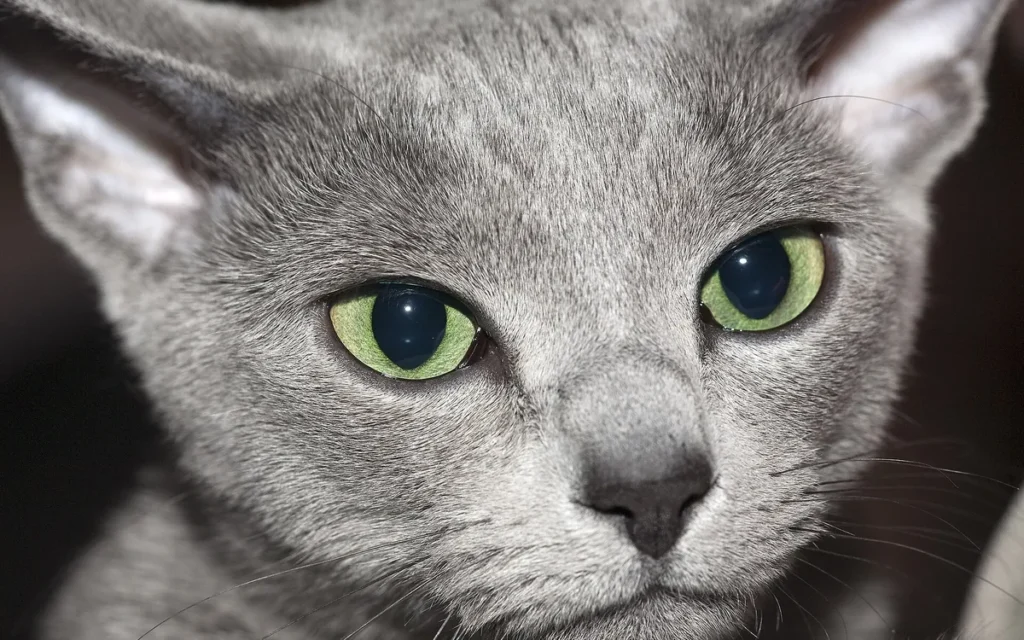
The Russian Blue is an elegant, medium-sized cat with a shimmering silver-tipped blue coat and vivid green eyes. It is gentle and quiet, and sheds relatively little. Here is how big Russian Blues get, a kitten growth chart, their care needs and health information.
How big do Russian Blues get?
According to CFA (the Cat Fanciers’ Association), adult male Russian Blues weigh 7–10 lb (3.2–4.5 kg) and females 5–8 lb (2.3–3.6 kg). That makes the Russian Blue a small cat on our size scale. Body type: medium-sized, fine-boned and graceful, with long legs.| Russian Blue | Weight |
|---|
CFA says males are rarely over 10 lb and females weigh about 5–8 lb; the 7 lb lower figure for males is from PetMD (7–12 lb for the breed). Purina gives a wider 8–15 lb.
Weight alone does not tell you whether a cat is healthy. A body condition score of 4–5 out of 9 (ribs easy to feel, a visible waist) matters more than the number on the scale.
Russian Blue growth chart: kitten weight by age
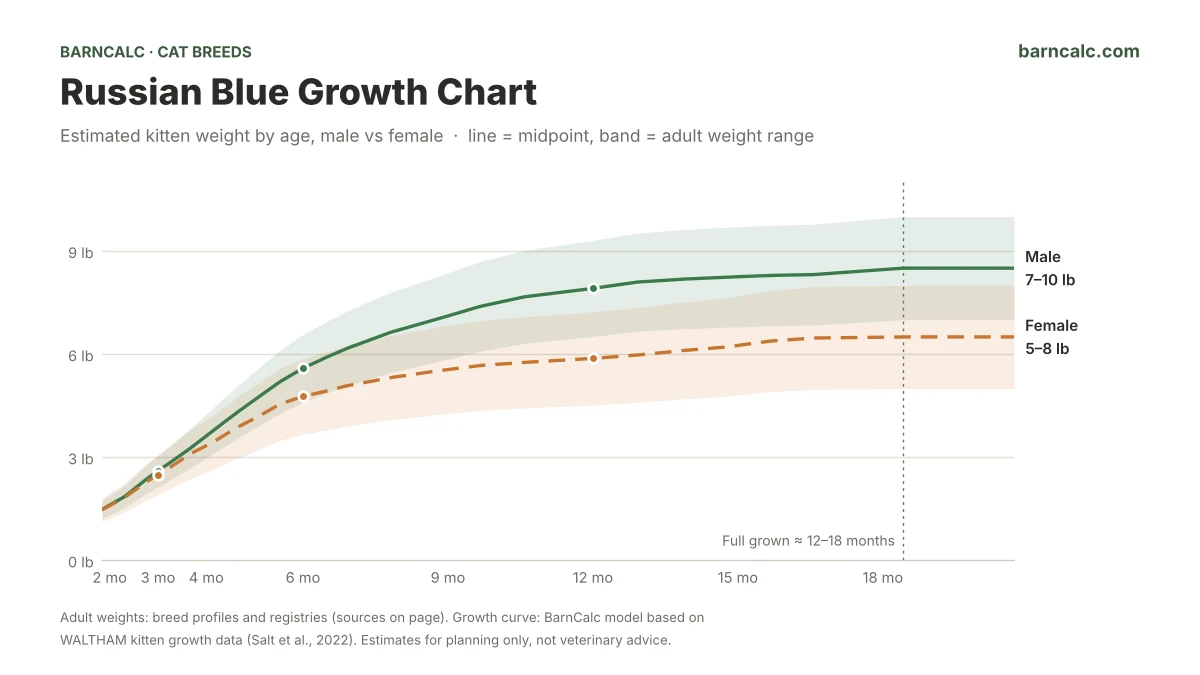
Russian Blue kitten weight chart (lb and kg)
| Age | Male kitten | Female kitten |
|---|---|---|
| 8 weeks | 1.5 lb0.7 kg | 1.5 lb0.7 kg |
| 10 weeks | 1.8 lb0.8 kg | 1.8 lb0.8 kg |
| 3 months | 2.6 lb1.2 kg | 2.5 lb1.1 kg |
| 4 months | 3.6 lb1.6 kg | 3.3 lb1.5 kg |
| 5 months | 4.7 lb2.1 kg | 4.1 lb1.9 kg |
| 6 months | 5.6 lb2.5 kg | 4.8 lb2.2 kg |
| 9 months | 7.1 lb3.2 kg | 5.6 lb2.5 kg |
| 12 months | 7.9 lb3.6 kg | 5.9 lb2.7 kg |
| Adult (12–18 months) | 8.5 lb3.9 kg | 6.5 lb2.9 kg |
When is a Russian Blue full grown?
Like most cats, Russian Blues grow fastest in the first six months and reach about 90% of their adult weight by their first birthday, then fill out until about 18 months. At 1 year a typical male is around 7.9 lb and a female around 5.9 lb, about 93% and 90% of their adult weight.How we calculate this: each figure is the midpoint of the breed’s adult weight range multiplied by the share of adult weight a kitten of that sex typically reaches at that age. The shares come from the WALTHAM kitten growth data (Salt et al., 2022; healthy domestic shorthair kittens). Kittens that are spayed or neutered early often grow a little faster and end up heavier.
Russian Blue kitten size calculator
Enter your kitten’s age and current weight to estimate how big your Russian Blue will be as an adult. The calculator is preset for the breed.Kitten Size Calculator
How big will my kitten get? Estimated adult weight from its current age and weight.
Most reliable from about 8 weeks to 12 months.
A kitchen or baby scale works best for small kittens.
Large breeds such as the Maine Coon, Ragdoll or Siberian keep growing for years.
Males usually end up heavier and keep growing a little longer.
| Age milestone | Projected weight |
|---|
Cat breed weight chart (lb & kg) by size
| Size | Typical adult weight | Example breeds |
|---|---|---|
| Small | under 8 lb / 3.6 kg | Singapura, Devon Rex, Cornish Rex |
| Medium | 8–12 lb / 3.6–5.4 kg | Most domestic cats, Abyssinian, Russian Blue, Persian |
| Large | 12 lb+ / 5.4 kg+ | Maine Coon, Ragdoll, Norwegian Forest Cat, Siberian |
Breed figures vary between sources; see each breed page for its own range and sources.
How it works: kittens reach a predictable share of their adult weight at each age. The tool divides your kitten's current weight by that share, using growth data from thousands of healthy kittens, and shows the result as a range. For slow-maturing breeds the same curve is stretched over the breed's longer growth period (our estimate).
Disclaimer: estimates for planning only, not veterinary advice. Growth varies with genetics, sex, diet and neutering (kittens neutered early often grow faster and end up heavier). Weigh your kitten regularly and talk to your vet.
Sources: Salt et al., PLOS ONE 2022 (WALTHAM kitten growth standards) · KGC1 dataset (CC BY 3.0)
Russian Blue personality and temperament
Russian Blues are gentle, quiet and loyal. They bond closely with their family and often attach to one person, but they can be shy with strangers at first. They like routine and a calm home. They are playful and intelligent, enjoy fetch and puzzle toys, and like to watch the household from a high perch.-
Activity level3/5
-
Affection4/5
-
Talkativeness1/5
-
Good with children3/5
-
Good with other pets4/5
-
Shedding2/5
Ratings are BarnCalc’s own 1–5 scale, based on the breed descriptions of the registries and the sources cited below. Individual cats vary.
History and origin
The Russian Blue is thought to come from the Archangel Isles in northern Russia, and early English shows listed these cats as Archangel Cats. They were first shown in London in 1875 and given their own class in 1912. Scandinavian and British breeders developed the breed in the early 20th century, and after World War II it was revived with crosses to blue British Shorthairs and blue point Siamese. American breeders later combined English and Scandinavian lines into today’s Russian Blue.Russian Blue lifespan and health
Most Russian Blues live 15–20 years. Curious how old that is in human terms? Try our cat age in human years calculator.Health conditions documented in the breed
- Obesity, from a hearty appetite
- Dental disease
- Polycystic kidney disease (PKD)
- Progressive retinal atrophy (PRA)
- Hypothyroidism (an inherited form has been described in the breed)
Health tests to ask a breeder for
Ask to see the results for both parents before you reserve a kitten:- DNA test for inherited hypothyroidism (TPO gene), listed for the breed by the University of Missouri feline genetics lab
- Blood typing before breeding
This is general information, not veterinary advice. Talk to your vet about your own cat.
Grooming and care
| Coat | Short, dense, plush double coat that feels silky and stands out from the body |
| Colors | Even bright blue with silver-tipped guard hairs that give a shimmering sheen; vivid green eyes that deepen with age |
| Grooming | Comb once or twice a week to keep the plush coat soft |
| Shedding and allergies | Not hypoallergenic, but sheds relatively little |
| Play and exercise | Moderate; enjoys fetch, puzzles and climbing to high perches, and can entertain itself |
| Indoor living | Calm indoor companion that likes a predictable routine; shy with strangers at first |
How much should a Russian Blue eat?
A healthy adult Russian Blue that is spayed or neutered needs roughly 155–260 kcal a day at the breed’s typical weight of 5–10 lb. Intact and very active cats need more; indoor cats that gain weight easily need less. The table below shows the full range for different adult weights.| Adult weight | Spayed / neutered (kcal/day) | Intact (kcal/day) | Dry food only* | Wet food only* |
|---|---|---|---|---|
| 5 lb2.3 kg | 155–180 | 180–205 | 39–45 g | 155–180 g |
| 8 lb3.6 kg | 220–260 | 260–295 | 55–65 g | 220–260 g |
| 10 lb4.5 kg | 260–305 | 305–350 | 65–76 g | 260–305 g |
Daily calories = 70 × body weight in kg0.75 × 1.2–1.4 for spayed/neutered adults or 1.4–1.6 for intact adults (AAHA 2021). *Example amounts for a dry food with 4 kcal per gram and a wet food with 1 kcal per gram; foods vary, so always check the calories on your food’s label and split the total into at least two meals. Kittens need much more energy per pound than adults: feed a kitten food until about 12 months.
Breeding and pregnancy
Like all cats, a pregnant Russian Blue carries her kittens for about 63–65 days (around nine weeks).Is a Russian Blue right for you?
A great fit for
Calm homes, adults or families with older children, owners who want a loyal and quiet cat, and people who want a low-shedding cat.Think twice if
You have a busy, noisy household with frequent visitors, or you change your routine often.Russian Blue FAQ
When is a Russian Blue full grown?
How big do Russian Blues get?
How much should a 6-month-old Russian Blue kitten weigh?
How long do Russian Blues live?
Are Russian Blues hypoallergenic?
Why is my Russian Blue gaining weight?
More cat calculators and guides
- Cat weight calculatorIs my cat overweight?
- Cat age in human yearsCalculator and age chart
- Cat gestation calculatorDue date and pregnancy timeline
- How long are cats pregnant?Signs and stages week by week
- All cat guidesBreeds, calculators and charts
Sources
- Cat Fanciers' Association (CFA)
- CFA breed standard
- PetMD
- Purina breed profile
- Feline genetic tests by breed (University of Missouri)
- Teng K. et al. (2024), life tables of annual life expectancy in cats in the UK (VetCompass), J Feline Med Surg
- Salt C. et al. (2022), growth standard charts for monitoring bodyweight in intact domestic shorthair kittens, PLOS ONE
- Kitten growth dataset (KGC1), University of Liverpool DataCat, CC BY 3.0
- PetMD: cat pregnancy, signs, stages and care (gestation 63–65 days)
- AAHA Nutrition and Weight Management Guidelines (2021): energy requirement calculations
Main photo: Nickolas Titkov from Moscow, Russian Federation, CC BY-SA 2.0, via Wikimedia Commons.
Reviewed by grupo barncalc.com on November 11, 2026. Estimates are for planning only and are not veterinary advice.