
- Dog breeds
- Large breed
- Sporting group
- Origin: Germany
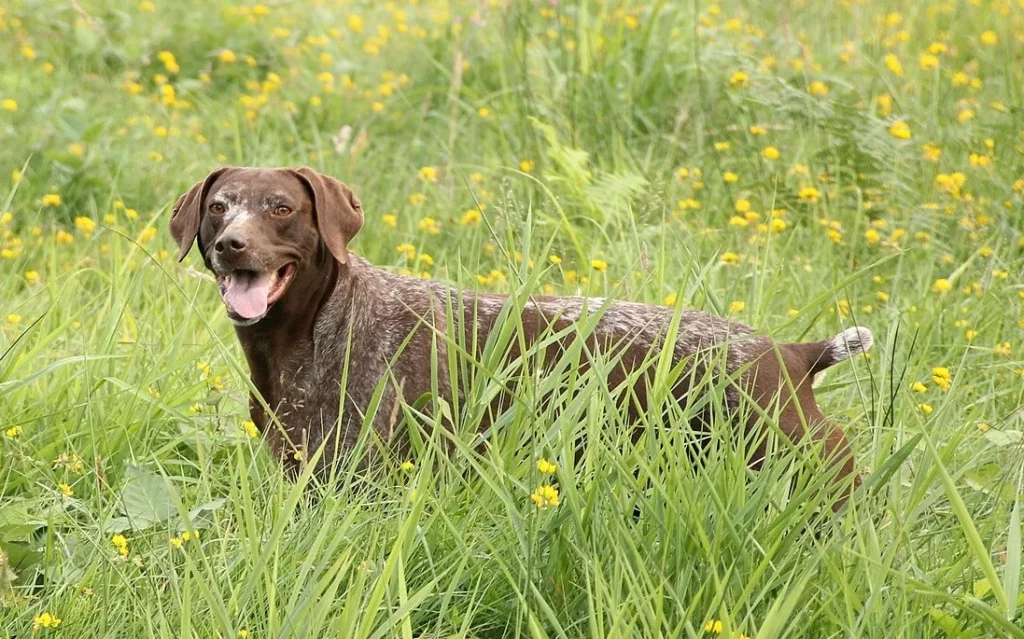
German Shorthaired Pointers are athletic, medium-large hunting dogs built for endurance. The AKC breed standard sets males at 55–70 lb and 23–25 in tall, and females at 45–60 lb and 21–23 in. Most GSPs reach adult weight at around 15–18 months, although they often stay puppyish for longer. This page covers a German Shorthaired Pointer growth chart by age, a size calculator preset for the breed, and sourced figures on lifespan, health testing, exercise and feeding.
How big do German Shorthaired Pointers get?
According to the AKC breed standard, adult male German Shorthaired Pointers weigh 55–70 lb (24.9–31.8 kg) and stand 23–25 in (58–64 cm) at the shoulder. Females are a little smaller at 45–60 lb (20.4–27.2 kg) and 21–23 in (53–58 cm). That makes the German Shorthaired Pointer a Large breed on our size scale.| German Shorthaired Pointer | Weight | Height |
|---|
Many healthy pets fall outside the show standard, especially from working or pet lines. Use body condition, not the scale alone, to judge a healthy weight.
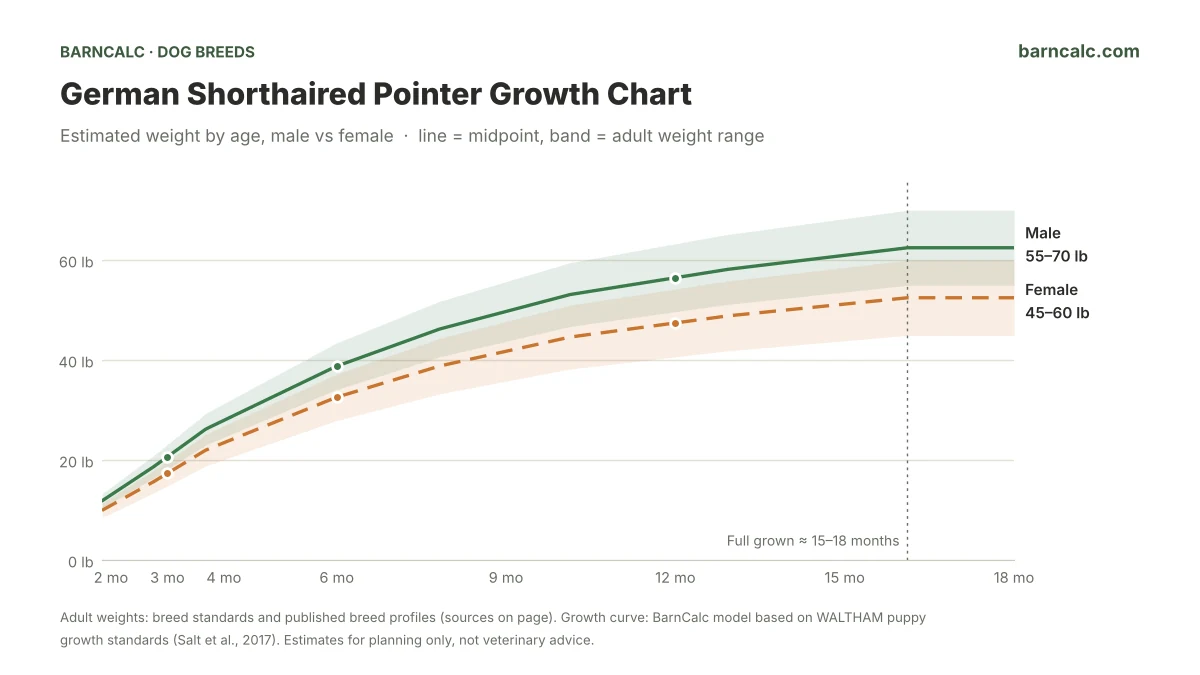
German Shorthaired Pointer growth chart: weight by age
| Age | Male | Female |
|---|---|---|
| 8 weeks | 12 lb5.4 kg | 10 lb4.5 kg |
| 3 months | 21 lb9.4 kg | 17 lb7.9 kg |
| 4 months | 28 lb12.7 kg | 23 lb10.7 kg |
| 6 months | 39 lb17.6 kg | 33 lb14.8 kg |
| 9 months | 50 lb22.6 kg | 42 lb19 kg |
| 12 months | 57 lb25.6 kg | 47 lb21.5 kg |
| Adult (15–18 months) | 62 lb28.3 kg | 52 lb23.8 kg |
When is a German Shorthaired Pointer full grown?
Large breeds like the German Shorthaired Pointer reach their adult weight at about 15–18 months. Most of the growth happens early: by 6 months a typical male is around 39 lb and a female around 33 lb, after which weight gain slows down as the dog fills out.How we calculate this: each figure is the midpoint of the breed’s adult weight range multiplied by the share of adult weight a large-size puppy typically reaches at that age (WALTHAM growth standards, Salt et al., 2017). It is the same model used by our Dog Size Calculator.
German Shorthaired Pointer puppy size calculator
Enter your puppy’s current age and weight to estimate how big your German Shorthaired Pointer will be as an adult. The calculator is preset for the breed.Dog Size Calculator
Predict how big your puppy will get — estimated adult weight from its current age and weight.
Best from ~8 weeks on; very young pups are less predictable.
Weigh on a flat scale, ideally before a meal.
Not sure? Use the size of the parents, or the larger parent for a mixed breed.
Males often finish a little heavier than females.
| Age milestone | Projected weight |
|---|
Dog breed weight chart (lb & kg) by size
| Size | Adult weight | Full-grown | Example breeds |
|---|---|---|---|
| Toy | 2–12 lb / 1–5.5 kg | ~8–10 mo | Chihuahua, Maltese, Toy Poodle, Pomeranian, Yorkie |
| Small | 12–25 lb / 5.5–11 kg | ~10–12 mo | Shih Tzu, French Bulldog, Mini Schnauzer, Mini Aussiedoodle |
| Medium | 25–50 lb / 11–23 kg | ~12–14 mo | Beagle, Border Collie, Cocker Spaniel, Std. Aussiedoodle* |
| Large | 50–100 lb / 23–45 kg | ~15–18 mo | Labrador, Golden Retriever, German Shepherd, Boxer |
| Giant | 100 lb+ / 45 kg+ | ~18–24 mo | Great Dane, Mastiff, St Bernard, Newfoundland |
*Standard Aussiedoodles span medium–large (≈40–70 lb / 18–32 kg); Mini Aussiedoodles are small (≈15–35 lb / 7–16 kg).
How it works: puppies of a given size reach a predictable share of their adult weight at each age. The tool divides your puppy's current weight by that share to estimate the adult figure, shown as a range.
Disclaimer: estimates for planning only — not veterinary advice. Growth varies with genetics, sex, nutrition and neuter status, especially for mixed and giant breeds. Keep records and consult your vet.
Sources: Salt et al., PLOS ONE 2017 (WALTHAM growth standards) · AKC — when puppies finish growing
German Shorthaired Pointer temperament and personality
GSPs are friendly, smart and enthusiastic dogs with seemingly endless energy. Bred to hunt all day, they need hard daily exercise such as running, swimming or field work, plus training to keep their minds busy. With enough outlets they are affectionate, people-oriented family dogs that usually get on well with children. Without them, they can become restless, destructive or escape artists. Their strong prey drive means small pets and unfenced spaces need care.-
Energy level5/5
-
Trainability5/5
-
Good with children4/5
-
Shedding3/5
-
Barking3/5
Ratings are BarnCalc’s own 1–5 scale, based on the breed standard and the sources cited below. Individual dogs vary.
History and origin
The German Shorthaired Pointer was developed in Germany during the 1800s as a versatile hunting dog that could point, retrieve on land and water, and track wounded game. Breeders combined older German bird dogs with other pointing breeds, including the English Pointer, to add speed and style. The breed’s stud book was established in the late 1800s, and the dogs spread across Europe and North America. The American Kennel Club recognized the German Shorthaired Pointer in 1930.German Shorthaired Pointer lifespan and health
Most German Shorthaired Pointers live 10–12 years. Want to know how old that is in human terms? Try our dog years calculator, or estimate an individual dog’s outlook with the dog life expectancy calculator.Health conditions documented in the breed
- Hip dysplasia
- Elbow dysplasia
- Bloat (gastric dilatation-volvulus)
- Heart disease
- Cone degeneration (day blindness)
Health tests to ask a breeder for
The breed’s parent club recommends these screenings for breeding dogs (ask to see the results for both parents):- Hip evaluation
- Elbow evaluation
- Cardiac exam
- Eye exam by a board-certified ophthalmologist
- Cone degeneration DNA test
This is general information, not veterinary advice. Talk to your vet about your own dog.
Exercise and grooming
| Exercise | 2+ hours of vigorous exercise a day |
| Grooming | Weekly brushing |
| Coat | Short, thick coat that feels tough to the hand |
| Low shedding | No – moderate shedder |
| Apartment living | Not ideal |
How much should a German Shorthaired Pointer eat?
A healthy, neutered adult German Shorthaired Pointer weighing 45–70 lb needs roughly 1,080–1,500 kcal a day. With a typical dry food of about 375 kcal per cup, that is about 2.9–4 cups a day, split into two meals. Active or intact dogs need more, while older or less active dogs need less. Always check the feeding guide on your food’s label.Breeding and pregnancy
Like all dogs, a pregnant German Shorthaired Pointer carries her puppies for about 63 days from ovulation. Most females come into heat about every 6 months.Is a German Shorthaired Pointer right for you?
A great fit for
Runners, hunters, hikers and active families who want a tireless, trainable outdoor companion.Think twice if
Apartments, sedentary owners or homes where the dog would be left alone for long hours.German Shorthaired Pointer FAQ
When is a German Shorthaired Pointer full grown?
How big will my German Shorthaired Pointer puppy get?
How much should a 6-month-old German Shorthaired Pointer weigh?
How long do German Shorthaired Pointers live?
How much exercise does a German Shorthaired Pointer need?
Do German Shorthaired Pointers shed?
Similar breeds
More dog calculators
- Dog size calculatorHow big will my puppy get?
- Dog years calculatorDog age in human years
- Life expectancyLifespan by breed and size
- Gestation calculatorDue date and whelping window
- Heat cycle calculatorNext heat and fertile days
- Raw dog food calculatorDaily portions by weight
Sources
- AKC official breed standard
- FCI breed standard
- Dogs Victoria breed profile
- AKC: breed club recommended health tests
- German Shorthaired Pointer Club of America: CHIC
- Salt C. et al. (2017), growth standard charts for monitoring bodyweight in dogs of different sizes, PLOS ONE
Main photo: ~riley, CC BY-SA 4.0, via Wikimedia Commons.
Reviewed by grupo barncalc.com on November 6, 2026. Estimates are for planning only and are not veterinary advice.