
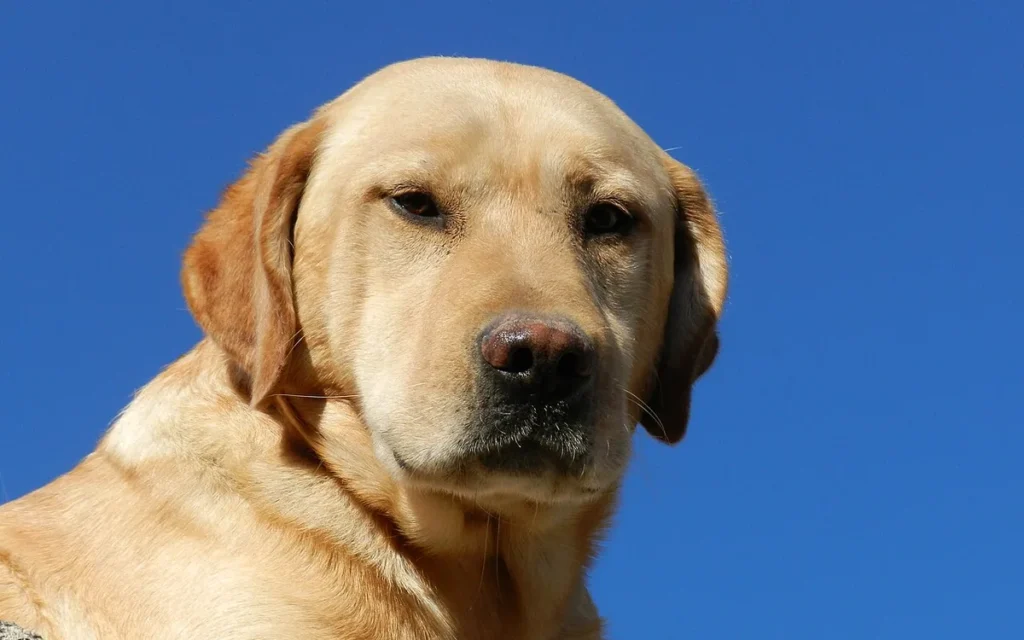
- Dog breeds
- Large breed
- Sporting group
- Origin: Great Britain (from Newfoundland stock)
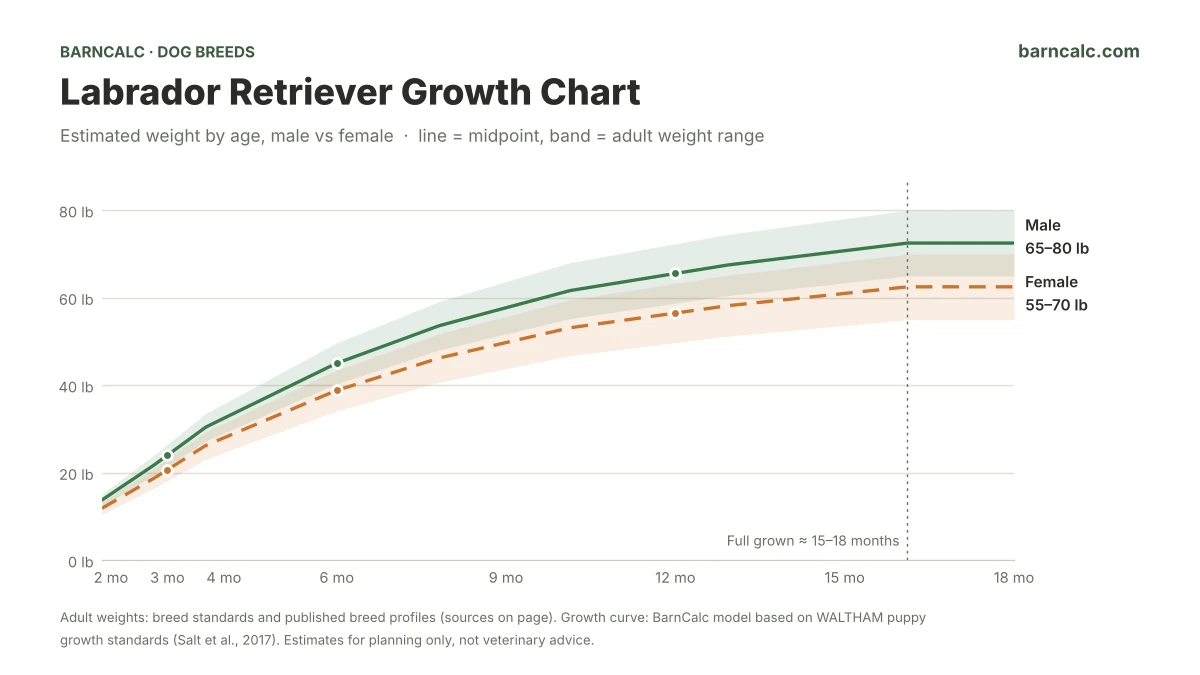
Labrador Retrievers are medium-large, athletic gundogs. According to the AKC breed standard, males weigh 65–80 lb and stand 22.5–24.5 in at the shoulder, while females weigh 55–70 lb. Labs grow fast in their first six months and usually reach adult weight at around 15–18 months, although many keep filling out after that. Here you’ll find a Labrador growth chart by age, a size calculator preset for the breed, and sourced figures on lifespan, health testing, exercise and food.
How big do Labrador Retrievers get?
According to the AKC breed standard, adult male Labrador Retrievers weigh 65–80 lb (29.5–36.3 kg) and stand 22.5–24.5 in (57–62 cm) at the shoulder. Females are a little smaller at 55–70 lb (24.9–31.8 kg) and 21.5–23.5 in (55–60 cm). That makes the Labrador Retriever a Large breed on our size scale.| Labrador Retriever | Weight | Height |
|---|
Many healthy pets fall outside the show standard, especially from working or pet lines. Use body condition, not the scale alone, to judge a healthy weight.
Labrador Retriever growth chart: weight by age
| Age | Male | Female |
|---|---|---|
| 8 weeks | 14 lb6.2 kg | 12 lb5.4 kg |
| 3 months | 24 lb10.9 kg | 21 lb9.4 kg |
| 4 months | 32 lb14.7 kg | 28 lb12.7 kg |
| 6 months | 45 lb20.4 kg | 39 lb17.6 kg |
| 9 months | 58 lb26.2 kg | 50 lb22.6 kg |
| 12 months | 66 lb29.7 kg | 57 lb25.6 kg |
| Adult (15–18 months) | 72 lb32.9 kg | 62 lb28.3 kg |
When is a Labrador Retriever full grown?
Large breeds like the Labrador Retriever reach their adult weight at about 15–18 months. Most of the growth happens early: by 6 months a typical male is around 45 lb and a female around 39 lb, after which weight gain slows down as the dog fills out.How we calculate this: each figure is the midpoint of the breed’s adult weight range multiplied by the share of adult weight a large-size puppy typically reaches at that age (WALTHAM growth standards, Salt et al., 2017). It is the same model used by our Dog Size Calculator.
Labrador Retriever puppy size calculator
Enter your puppy’s current age and weight to estimate how big your Labrador Retriever will be as an adult. The calculator is preset for the breed.Dog Size Calculator
Predict how big your puppy will get — estimated adult weight from its current age and weight.
Best from ~8 weeks on; very young pups are less predictable.
Weigh on a flat scale, ideally before a meal.
Not sure? Use the size of the parents, or the larger parent for a mixed breed.
Males often finish a little heavier than females.
| Age milestone | Projected weight |
|---|
Dog breed weight chart (lb & kg) by size
| Size | Adult weight | Full-grown | Example breeds |
|---|---|---|---|
| Toy | 2–12 lb / 1–5.5 kg | ~8–10 mo | Chihuahua, Maltese, Toy Poodle, Pomeranian, Yorkie |
| Small | 12–25 lb / 5.5–11 kg | ~10–12 mo | Shih Tzu, French Bulldog, Mini Schnauzer, Mini Aussiedoodle |
| Medium | 25–50 lb / 11–23 kg | ~12–14 mo | Beagle, Border Collie, Cocker Spaniel, Std. Aussiedoodle* |
| Large | 50–100 lb / 23–45 kg | ~15–18 mo | Labrador, Golden Retriever, German Shepherd, Boxer |
| Giant | 100 lb+ / 45 kg+ | ~18–24 mo | Great Dane, Mastiff, St Bernard, Newfoundland |
*Standard Aussiedoodles span medium–large (≈40–70 lb / 18–32 kg); Mini Aussiedoodles are small (≈15–35 lb / 7–16 kg).
How it works: puppies of a given size reach a predictable share of their adult weight at each age. The tool divides your puppy's current weight by that share to estimate the adult figure, shown as a range.
Disclaimer: estimates for planning only — not veterinary advice. Growth varies with genetics, sex, nutrition and neuter status, especially for mixed and giant breeds. Keep records and consult your vet.
Sources: Salt et al., PLOS ONE 2017 (WALTHAM growth standards) · AKC — when puppies finish growing
Labrador Retriever temperament and personality
The breed standard sums up the Labrador as friendly, active and outgoing, and few breeds are as consistently people-friendly. Labs are eager to work, food-motivated and easy to train, which is why they dominate guide, assistance and detection work. They are also high-energy, especially in their first few years, and need daily exercise and something to do. Their love of food makes them prone to weight gain, so portion control matters as much as exercise.-
Energy level5/5
-
Trainability5/5
-
Good with children5/5
-
Shedding4/5
-
Barking3/5
Ratings are BarnCalc’s own 1–5 scale, based on the breed standard and the sources cited below. Individual dogs vary.
History and origin
Despite the name, the Labrador’s ancestors came from Newfoundland, not Labrador. Fishermen there used the St. John’s water dog to retrieve nets and fish from icy water. In the early 1800s British aristocrats, including the Earls of Malmesbury and the Dukes of Buccleuch, brought these dogs home and developed them into a shooting retriever; the third Earl of Malmesbury is credited with first calling them ‘Labradors’. The Kennel Club recognized the breed in 1903, and the American Kennel Club registered its first Labrador in 1917.Labrador Retriever lifespan and health
Most Labrador Retrievers live 11–13 years. Want to know how old that is in human terms? Try our dog years calculator, or estimate an individual dog’s outlook with the dog life expectancy calculator.Health conditions documented in the breed
- Hip dysplasia
- Elbow dysplasia
- Exercise-induced collapse (EIC)
- Progressive retinal atrophy (PRA)
- Centronuclear myopathy (CNM)
- Obesity
Health tests to ask a breeder for
The breed’s parent club recommends these screenings for breeding dogs (ask to see the results for both parents):- Hip evaluation
- Elbow evaluation
- Eye exam by a board-certified ophthalmologist
- DNA tests for EIC, CNM, PRA-prcd and the D locus (dilute)
This is general information, not veterinary advice. Talk to your vet about your own dog.
Exercise and grooming
| Exercise | 1 hour+ of exercise a day |
| Grooming | Weekly brushing, more during seasonal sheds |
| Coat | Short, dense, water-resistant double coat |
| Low shedding | No – heavy seasonal shedder |
| Apartment living | Possible with plenty of daily exercise |
How much should a Labrador Retriever eat?
A healthy, neutered adult Labrador Retriever weighing 55–80 lb needs roughly 1,250–1,660 kcal a day. With a typical dry food of about 375 kcal per cup, that is about 3.3–4.4 cups a day, split into two meals. Active or intact dogs need more, while older or less active dogs need less. Always check the feeding guide on your food’s label.Breeding and pregnancy
Like all dogs, a pregnant Labrador Retriever carries her puppies for about 63 days from ovulation. Most females come into heat about every 6 months.Is a Labrador Retriever right for you?
A great fit for
Active families, people who enjoy long walks, swimming or dog sports, and first-time owners willing to invest in training.Think twice if
Owners who are away all day, people who want a tidy, low-shedding dog, or homes that can’t keep food out of reach.Labrador Retriever FAQ
When is a Labrador Retriever full grown?
How big will my Labrador Retriever puppy get?
How much should a 6-month-old Labrador Retriever weigh?
How long do Labrador Retrievers live?
What is the difference between show and field Labradors?
Do Labradors shed?
Similar breeds
- Golden RetrieverSize, growth chart & lifespan
- German Shorthaired PointerSize, growth chart & lifespan
More dog calculators
- Dog size calculatorHow big will my puppy get?
- Dog years calculatorDog age in human years
- Life expectancyLifespan by breed and size
- Gestation calculatorDue date and whelping window
- Heat cycle calculatorNext heat and fertile days
- Raw dog food calculatorDaily portions by weight
Sources
- AKC official breed standard
- FCI breed standard
- American Kennel Club (AKC)
- AKC: breed club recommended health tests
- Labrador Retriever Club: health statement
- Salt C. et al. (2017), growth standard charts for monitoring bodyweight in dogs of different sizes, PLOS ONE
Main photo: Miguel Ángel Martínez González, CC BY-SA 3.0, via Wikimedia Commons.
Reviewed by grupo barncalc.com on November 6, 2026. Estimates are for planning only and are not veterinary advice.